

Three decades of faster, smarter & better
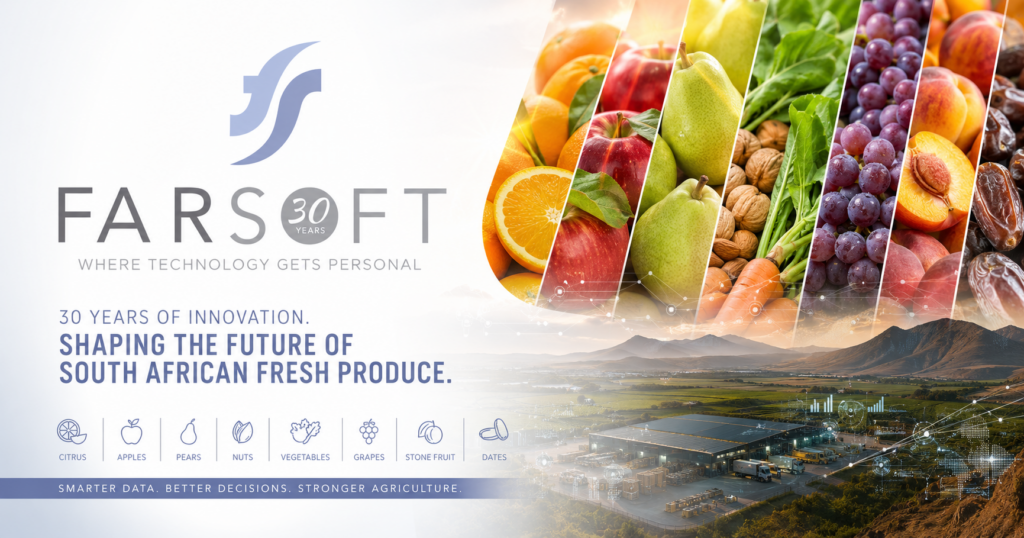 There are few industries as deceptively complex as fresh produce. But beneath the pastoral imagery of growing fresh produce lies a relentless choreography of logistics, compliance, timing, traceability, quality control and split-second decision-making.
For the past three decades, FarSoft Solutions has quietly helped the Southern African fresh produce industry navigate exactly that complexity.
This year marks the Wellington-based company’s 30-year milestone: three decades spent building the invisible digital infrastructure behind packhouses, exporters, cold rooms, orchards, vineyards and fields in South Africa with its ViTrax suite of solutions.
In many ways, FarSoft’s story mirrors the evolution of South African agriculture itself. When the company was founded in 1996 by Freddie Roux, the fresh produce industry still relied heavily on manual systems, instinct, fragmented reporting and delayed information flows. Export logistics were comparatively simple. Compliance requirements were lighter. Data existed in pockets rather than ecosystems. Today, the landscape is almost unrecognisable.
Modern fresh produce production has become a precision industry driven by analytics, traceability, forecasting and real-time operational intelligence. Export regulations have intensified. Global competition has sharpened. Retailers and overseas markets demand unprecedented transparency and consistency. In that environment, information is no longer administrative support. It’s operational survival. And FarSoft understood that long before “digital transformation” became corporate vocabulary.
Over the years, the company developed specialised systems for the fresh produce industry, including ViTrax packhouse management tools, pallet tracking, bin tracking, production reporting and radio-frequency scanning systems designed specifically for agricultural realities.
But what distinguishes FarSoft is not merely the software itself. It’s the company’s understanding that agriculture is a living environment. As such, technology only succeeds if it understands the rhythms of farms, cold storage facilities and export operations. That philosophy remains central to the company culture today. Director Gerhard Nel once remarked that even FarSoft’s software developers are expected to understand the entire fruit chain because ‘you can’t build proper, easily-accessible systems for clients if you don’t know their business thoroughly’.
As such, new team members spend time working within client operations, learning packhouse and cold-storage processes first-hand before contributing to system development. That practical immersion helps explain why the company’s systems resonate so strongly within the agricultural sector. They’re shaped inside the realities of production lines, export deadlines and orchard-level problem solving.
Today, FarSoft’s ViTrax systems assist growers and exporters in analysing historical orchard/vineyard/field data, tracking quality trends, monitoring product age, managing logistics and identifying latent defects before fresh produce even reaches the packing stage. That capability has become critical in a global market where timing, quality and traceability are inseparable from profitability. Data is no longer passive information. It’s a predictive tool.
Despite operating in a highly technical space, FarSoft has remained grounded about its identity: building its reputation steadily through long-term relationships.
South Africa’s fresh produce export sector has become one of the country’s major agricultural success stories, competing aggressively in international markets. FarSoft became part of that transformation. Its systems help create the continuity modern exporters require—connecting orchards to packhouses, packhouses to cold storage, and storage facilities to shipping and market intelligence.
Behind an industry which is more connected, more data-driven, more accountable and more precise sits a Wellington company that understood very early on that the future of agriculture would belong not only to those who could grow fresh produce—but to those who could understand the complexities.


